Enhanced heat transfer across a nanogap by thermal resonance between adsorbed liquid layers
Abstract
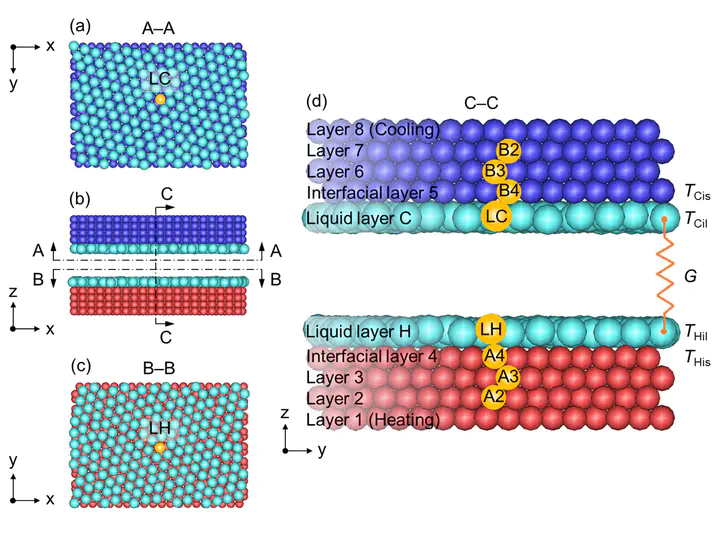
Phonon transmission across a vacuum gap can be induced by quasi-Casimir coupling between interfacial layers without electromagnetic fields. However, there is still a lack of understanding of heat transfer across a nanogap via liquid layers adsorbed on superhydrophilic solid surfaces. Herein, classical nonequilibrium molecular dynamics simulations were carried out to clarify phonon transmission across the nanogap induced by the quasi-Casimir coupling at the solid–liquid interface. The dimensions of simulation system were Lx = 5.552 nm, Ly = 3.847 nm, and Lz = 2.402–4.169 nm. The gap distance D between two solid walls ranged from 0.588 to 2.352 nm. Each solid wall was constructed of 1280 platinum atoms. The smaller distance d of 0.193–2.057 nm was obtained due to the liquid layers of 190–380 argon atoms adsorbed on the solid surfaces. The molecular interactions were modeled by the Lennard-Jones potential. Periodic boundary conditions were employed along the x- and y-directions. We found that the net heat flux q across the nanogap is enhanced significantly owing to the thermal resonance between two liquid layers compared with the cases of vacuum gap.

Wentao Chen
Associate Professor
My research interests include extreme near-field heat transfer, thermal transport at the solid-solid and solid-liquid interface, and molecular dynamics simulation.